A09 — Advanced Triton & FlashAttention¶
Track A · Module 09 · Status: DONE · Est. 9 hours · Depth 4/5
Prerequisites: A04 (block reductions), A06 (tiling,
tl.dot), A07 (online softmax, fusion), A08 (@triton.jit,tl.program_id, maskedtl.load/tl.store,tl.constexpr,triton.cdiv). Backend: Triton (Python) on either vendor. Setup: SETUP.md · Terms: GLOSSARY.md · Sources: REFERENCES.md.
This is the capstone of Track A. Everything you have built so far converges here: the tiling from A06 §3, the online softmax from A07 §3, and the block reductions from A04 §3 fuse into one kernel — the kernel that decides how long a context modern LLMs can afford.
1. TL;DR + Layman analogy¶
TL;DR. Standard attention computes S = QK^T and writes the whole (N, N) score
matrix to HBM, reads it back for the
softmax, writes the probabilities, and reads
them again for PV. The useful compute is O(N²·d) but the memory traffic is
O(N²) — so as context grows the kernel spends its life shuttling a matrix it does
not need. FlashAttention
(Dao et al. 2022)
never materializes S: it tiles Q, K and V, keeps a
running output accumulator plus the online-softmax (max, sum) statistics on-chip,
and rescales the accumulator whenever a new block reveals a larger max. Traffic drops
to O(N·d), the result is exact (not an approximation), and attention moves from
the bandwidth roof to the compute roof. This module builds that kernel in
Triton,
adds causal masking that skips future blocks rather than merely masking them, and
autotunes the tile shape.
Layman analogy — totalling a ledger without ever printing the spreadsheet. You
are asked for the weighted average of a million-row ledger, where each row's weight
is exp(score). The naive clerk prints the entire spreadsheet of scores, walks back
to the filing cabinet to find the largest one, walks back again to exponentiate every
row, and walks back a third time to take the weighted sum. Every walk to the cabinet
is the slow part; the arithmetic was never the problem.
The FlashAttention clerk never prints anything. She keeps two numbers on a
notepad — the largest score seen so far, and a running sum — plus a running
total of the weighted values. She takes one page of the ledger at a time. When a
page contains a score larger than anything before it, she does not start over: she
multiplies her running sum and running total by a single correction factor
(exp(old_max − new_max)), then adds the new page. When she reaches the end, she
divides once. The answer is identical to the naive clerk's, and she visited the
cabinet once.
Where the analogy breaks — and these breaks are the module's engineering content:
- One clerk, thousands of desks. The real kernel has thousands of programs, each owning a block of rows of Q, all streaming K and V independently. There is no single sequential pass.
- The notepad has a hard size limit. "Keep it on-chip" means registers and LDS / shared memory, and their budget is what caps the tile shape. Choose too large a tile and the accumulator spills to HBM, which reintroduces exactly the traffic you were avoiding.
- The rescale is not free.
exp(old_max − new_max)multiplies the entire running accumulator, not a single number —BLOCK_M × HEAD_DIMvalues every time the max moves. It is cheap relative to the traffic it saves, but it is real work, and it is why the fused kernel does slightly more arithmetic than the unfused one.
%%{init: {
  'theme': 'base',
  'themeVariables': {
    'primaryColor': '#F8FAFC',
    'primaryTextColor': '#0F172A',
    'primaryBorderColor': '#0891B2',
    'lineColor': '#64748B',
    'secondaryColor': '#E0F2FE',
    'tertiaryColor': '#EEF2FF',
    'fontFamily': 'Inter, Segoe UI, sans-serif'
  }
}}%%
flowchart LR
  subgraph LEDGER["The clerk"]
    direction TB
    PAGE["one page of the ledger"]
    NOTE["notepad: running max,<br/>running sum, running total"]
    DIV["divide once at the end"]
    PAGE --> NOTE --> DIV
  end
  subgraph KERNEL["The kernel"]
    direction TB
    TILE["one K/V block<br/>BLOCK_N keys"]
    STATE["registers: m_i, l_i,<br/>acc (BLOCK_M x HEAD_DIM)"]
    NORM["acc / l_i, then store O"]
    TILE --> STATE --> NORM
  end
  LEDGER -.->|"same algorithm"| KERNEL

  classDef neutral fill:#F8FAFC,stroke:#0891B2,color:#0F172A
  classDef trackA fill:#0891B2,stroke:#0F172A,color:#fff
  classDef success fill:#10B981,stroke:#0F172A,color:#fff
  class PAGE,NOTE neutral
  class TILE,STATE trackA
  class DIV,NORM success
Read it as a mapping, not a pipeline: the notepad is the register-resident (m, l,
acc) triple, one ledger page is one BLOCK_N slice of keys, and "divide once" is the
single acc / l_i before the store.
By the end of this module you can: show in bytes why unfused attention is
memory-bound; write the online rescaling update and prove it exact; build a
forward-only FlashAttention-style Triton kernel verified against PyTorch; make it
causal and faster by skipping future blocks; drive triton.autotune deliberately,
including its latency cost; and articulate precisely why your kernel is not
flash-attn.
2. First Principles¶
Start with the bytes, not the API¶
Self-attention for one head, sequence length N, head dimension d, as
Attention Is All You Need
defines it:
S = Q K^T / sqrt(d) (N, d) x (d, N) -> (N, N)
P = softmax(S, axis=-1) (N, N) -> (N, N)
O = P V (N, N) x (N, d) -> (N, d)
Now count. In fp16 (2 bytes per element), the score matrix alone is 2·N² bytes per
head:
| N | S = 2·N² bytes |
Q, K, V, O together = 8·N·d bytes (d = 128) |
|---|---|---|
| 1,024 | 2 MiB | 1 MiB |
| 4,096 | 32 MiB | 4 MiB |
| 16,384 | 512 MiB | 16 MiB |
At N = 16k, one head's intermediate is 32× larger than all four of its actual
inputs and outputs combined. And the unfused pipeline moves that intermediate
across the HBM boundary four times — written by the matmul, read by the softmax,
written by the softmax, read by the second matmul:
naive traffic per head = 8·N·d + 4·(2·N²) = 8·N·d + 8·N² bytes (fp16)
fused traffic per head = 8·N·d bytes (fp16)
ratio = 1 + N/d
That closed form is the whole argument. d is fixed by the architecture (64–128 in
practice); N has gone from 512 to 128k+ across model generations. At d = 128:
9× at N = 1k, 33× at N = 4k, 129× at N = 16k. Note what cancels: the dtype
disappears. Moving to fp8 halves both sides and changes nothing about whether you
should fuse.
Why "memory-bound" is a property of the implementation¶
Useful compute per head is 4·N²·d flops (two matmuls at 2·N²·d each). Divide by
the traffic above:
naive: AI = 4·N²·d / (8·N·d + 8·N²) = N·d / (2·(N + d)) -> d/2 as N grows
fused: AI = 4·N²·d / (8·N·d) = N/2 -> unbounded
The unfused implementation's
arithmetic intensity saturates at
d/2 — 64 flops per byte at d = 128 — and never improves, no matter how long the
sequence gets. At
N = 4096 it is already at 62.1, within 3% of its ceiling. Adding context adds flops
and bytes in the same proportion, so you cannot compute your way out.
The fused version's intensity grows linearly in N. With a
roofline ridge point
around 200 flops/byte (order-of-magnitude: ~1000 TFLOP/s fp16 over ~5 TB/s — use your
own GPU's numbers), the fused kernel crosses into compute-bound at N ≈ 400, while
the naive one is stuck on the bandwidth roof forever. Attention is not intrinsically
memory-bound;
unfused attention is. That sentence is the paper
(Dao et al. 2022).
The traffic picture¶
%%{init: {
'theme': 'base',
'themeVariables': {
'primaryColor': '#F8FAFC',
'primaryTextColor': '#0F172A',
'primaryBorderColor': '#0891B2',
'lineColor': '#64748B',
'secondaryColor': '#E0F2FE',
'tertiaryColor': '#EEF2FF',
'fontFamily': 'Inter, Segoe UI, sans-serif'
}
}}%%
flowchart TB
subgraph NAIVE["Unfused: S lives in HBM"]
direction TB
HBM1["HBM"]
K1["kernel 1: QK^T"]
K2["kernel 2: softmax"]
K3["kernel 3: PV"]
HBM1 -->|"read Q, K"| K1
K1 -->|"write S: 2N^2 bytes"| HBM1
HBM1 -->|"read S: 2N^2"| K2
K2 -->|"write P: 2N^2"| HBM1
HBM1 -->|"read P: 2N^2 + read V"| K3
K3 -->|"write O"| HBM1
end
subgraph FUSED["Fused: S never leaves the chip"]
direction TB
HBM2["HBM"]
ONCHIP["registers + LDS<br/>Q tile, K/V block,<br/>m_i, l_i, acc"]
HBM2 -->|"read Q, K, V once"| ONCHIP
ONCHIP -->|"S tile computed, consumed,<br/>discarded - never stored"| ONCHIP
ONCHIP -->|"write O once"| HBM2
end
classDef warn fill:#FEF3C7,stroke:#F59E0B,color:#0F172A
classDef success fill:#10B981,stroke:#0F172A,color:#fff
classDef neutral fill:#F8FAFC,stroke:#0891B2,color:#0F172A
class HBM1,K1,K2,K3 warn
class HBM2 neutral
class ONCHIP,FUSED successCount the arrows crossing the HBM boundary: six on the left, two on the right — and
four of the six carry an N²-sized payload, which is why the left side scales
quadratically and the right side linearly.
Every box above is the same size, which hides the thing that matters. Drawn to scale,
the four N² crossings dwarf everything else in the problem:
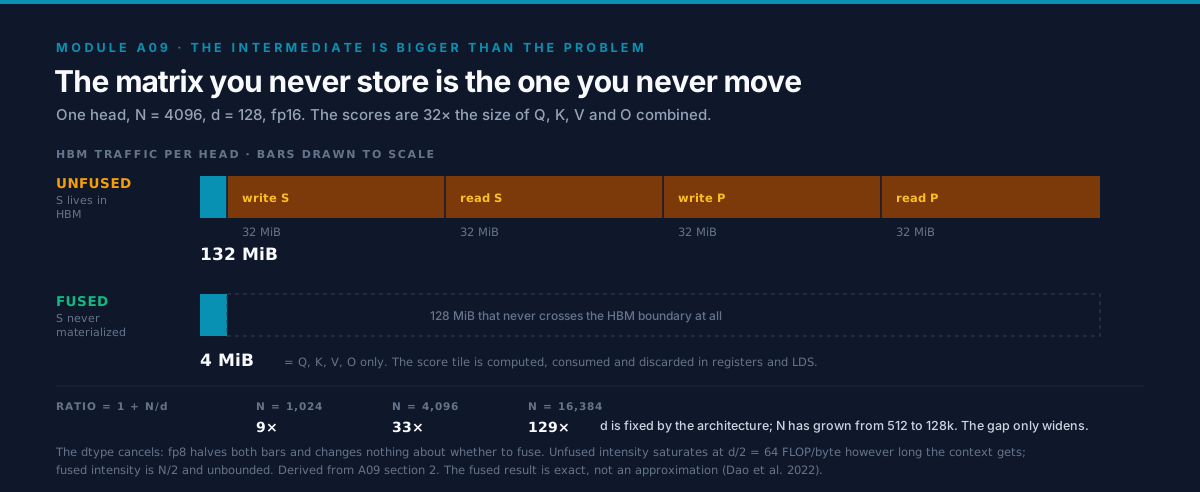
The cyan sliver on both bars is identical — it is Q, K, V and O, the data you cannot avoid touching. Everything else on the top bar is the score matrix crossing the boundary four times, and it is the only difference between the two implementations.
The fix is A07's trick, generalized¶
A07 §3
showed that a softmax can be computed in one streaming pass by carrying a
running (max, sum) pair and rebasing whenever the max moves
(Milakov & Gimelshein 2018).
FlashAttention is
that same rebasing applied to a matmul → softmax → matmul chain: carry a third
piece of state, the output accumulator acc, and rebase it by the same factor.
Because acc is a linear function of the exponentials, one scalar per row rebases the
whole thing. Nothing else about the algorithm is new — which is exactly why this is
the right capstone for the track.
3. Deep Dive¶
The rescaling update, written out¶
Program state, per query row (so all of the below is per-row, and the kernel does
BLOCK_M rows at a time):
| State | Shape | Invariant it maintains |
|---|---|---|
m_i |
(BLOCK_M,) |
max score seen so far |
l_i |
(BLOCK_M,) |
sum(exp(s_j - m_i)) over all keys seen so far |
acc |
(BLOCK_M, HEAD_DIM) |
sum(exp(s_j - m_i) · V_j) over all keys seen so far |
Both l_i and acc are the true sums scaled by one common factor, exp(-m_i). Now a
new block arrives with row max m_new_block:
m = max(m_old, m_new_block) the new common reference point
alpha = exp(m_old - m) correction factor, in (0, 1]
P_new = exp(qk_block - m) this block, referenced to m
l = l_old * alpha + rowsum(P_new)
acc = acc_old * alpha + P_new @ V_new
Why it is exactly equal to the unfused result. Rebasing the reference point from
m_old to m multiplies every already-accumulated term by
exp(-m) / exp(-m_old) = exp(m_old - m) = alpha. That is a single scalar per row
applied uniformly to every term, so no information is lost and no term is privileged.
At the end, the final acc / l cancels the shared exp(-m) factor entirely:
acc / l = [ sum_j exp(s_j - m) · V_j ] / [ sum_j exp(s_j - m) ]
= [ sum_j exp(s_j) · V_j ] / [ sum_j exp(s_j) ] = softmax(s) @ V
This is an exact algebraic identity, not an approximation. FlashAttention is not a "fast approximate attention" method; it returns the same answer as the textbook version, up to floating-point rounding. Say this precisely in an interview — a surprising number of candidates believe it approximates.
Why it is numerically safe. Every exponent is ≤ 0 by construction: qk - m ≤ 0
because m is at least this block's max, and m_old - m ≤ 0 because m is a max
including m_old. So exp() can never overflow. The worst case is underflow to zero,
which is the mathematically correct answer for a score far below the row max. This is
the same guarantee the unfused max-subtraction gives you — the fused version just
maintains it incrementally.
Two implementation traps that follow directly from the math:
- Mask with a large finite negative, not
-inf. The hazard is a row whose entire seen range is masked, because only then is the running max still-infwhen the new block max is also-inf— andalpha = exp(-inf + inf) = NaN. That happens for the padding rows of the tail query block, and for real rows under any windowed, packed-varlen, or arbitrary mask that leaves a program's first visited block fully disallowed. With-1e9the running max stays finite andexp(-1e9 - m)underflows cleanly to 0. The upstream Triton tutorial uses-1e6for the same reason. - Keep
accin fp32.Pgets rounded to fp16/bf16 before the secondtl.dotso it can feed the matrix cores — production FlashAttention does the same — but the accumulator must stay wide, or the running sum degrades overN/BLOCK_Niterations.
The kernel, in pseudocode¶
program (pid_m, batch*head):
load Q tile [BLOCK_M, HEAD_DIM] # once; reused for the whole walk
m_i = -inf; l_i = 0; acc = 0
for start_n in 0 .. hi step BLOCK_N:
load K block [HEAD_DIM, BLOCK_N] # loaded already transposed
qk = dot(Q, K) * scale # the S tile: lives and dies in registers
apply bounds mask (+ causal mask on the diagonal block)
m_new = max(m_i, rowmax(qk))
alpha = exp(m_i - m_new)
p = exp(qk - m_new)
l_i = l_i * alpha + rowsum(p)
acc = acc * alpha
load V block [BLOCK_N, HEAD_DIM]
acc = dot(p.to(V.dtype), V, acc) # fp32 accumulate
m_i = m_new
store O tile = acc / l_i
Code: triton/flash_attention.py.
%%{init: {
'theme': 'base',
'themeVariables': {
'primaryColor': '#F8FAFC',
'primaryTextColor': '#0F172A',
'primaryBorderColor': '#0891B2',
'lineColor': '#64748B',
'secondaryColor': '#E0F2FE',
'tertiaryColor': '#EEF2FF',
'fontFamily': 'Inter, Segoe UI, sans-serif'
}
}}%%
flowchart TB
START["load Q tile once<br/>m_i = -inf, l_i = 0, acc = 0"]
LOADK["load K block<br/>compute qk = dot(Q, K) * scale"]
MASK["mask: out-of-range keys,<br/>causal diagonal"]
MAXUP["m_new = max(m_i, rowmax(qk))<br/>alpha = exp(m_i - m_new)"]
RESCALE["l_i = l_i * alpha + rowsum(p)<br/>acc = acc * alpha"]
ACCUM["load V block<br/>acc = dot(p, V, acc) in fp32"]
MORE{"more K/V blocks?"}
DONE["O = acc / l_i<br/>store once"]
START --> LOADK --> MASK --> MAXUP --> RESCALE --> ACCUM --> MORE
MORE -->|"yes"| LOADK
MORE -->|"no"| DONE
classDef trackA fill:#0891B2,stroke:#0F172A,color:#fff
classDef warn fill:#FEF3C7,stroke:#F59E0B,color:#0F172A
classDef success fill:#10B981,stroke:#0F172A,color:#fff
classDef neutral fill:#F8FAFC,stroke:#0891B2,color:#0F172A
class START,LOADK,ACCUM trackA
class MASK,MORE warn
class MAXUP,RESCALE neutral
class DONE successThe loop back-edge is the entire point: qk is created and destroyed inside one
iteration, so the (N, N) matrix never exists anywhere but registers, one
BLOCK_M × BLOCK_N tile at a time.
Causal masking: skipping beats masking¶
A causal (decoder) model requires query i to attend only to keys j ≤ i. There are
two completely different things to do about that, and conflating them is the most
common review finding in attention PRs:
| What it does | What it buys | |
|---|---|---|
| Block skipping | Never load or multiply K/V blocks lying strictly in the future of this query block | The performance. Roughly 2×: loads, tl.dot, and exp all avoided |
| Diagonal masking | Element-wise mask inside the one block straddling the diagonal | The correctness. Costs a little extra work |
The loop bound is the whole trick:
The min with n_ctx is load-bearing, not cosmetic: without it the last, partial
query block walks past the end of the sequence doing fully-masked work.
The accounting. With BLOCK_M = BLOCK_N = b and T = N/b blocks per axis, query
block i visits i + 1 key blocks, so the visited fraction is
(1 + 2 + ... + T)/T² = (T+1)/(2T) → 1/2. The measured speedup is always a bit
less than 2×, for three reasons worth naming: the diagonal block computes a full tile
and discards half of it; the programs are now imbalanced (pid_m = 0 walks one block,
the last walks T), so the launch ends with the slowest program
(FlashAttention-2 is a
work-partitioning answer to exactly this); and the Q load, O store, and launch
overhead are fixed costs.
%%{init: {
'theme': 'base',
'themeVariables': {
'primaryColor': '#F8FAFC',
'primaryTextColor': '#0F172A',
'primaryBorderColor': '#0891B2',
'lineColor': '#64748B',
'secondaryColor': '#E0F2FE',
'tertiaryColor': '#EEF2FF',
'fontFamily': 'Inter, Segoe UI, sans-serif'
}
}}%%
flowchart LR
subgraph GRID["Causal grid, query block pid_m = 2 of 4"]
direction TB
B0["key block 0<br/>fully in the past"]
B1["key block 1<br/>fully in the past"]
B2["key block 2<br/>DIAGONAL"]
B3["key block 3<br/>fully in the future"]
end
B0 --> FULL["compute, no mask needed"]
B1 --> FULL
B2 --> MASKED["compute, then mask<br/>where key index exceeds query index"]
B3 --> SKIP["never loaded:<br/>loop bound stops before it"]
classDef trackA fill:#0891B2,stroke:#0F172A,color:#fff
classDef warn fill:#FEF3C7,stroke:#F59E0B,color:#0F172A
classDef success fill:#10B981,stroke:#0F172A,color:#fff
classDef neutral fill:#F8FAFC,stroke:#0891B2,color:#0F172A
class B0,B1 trackA
class B2 warn
class B3 neutral
class FULL,MASKED success
class SKIP successOnly one block per query block ever needs the element-wise mask — which is why
production kernels split the loop into an unmasked body plus a single masked diagonal
stage (the STAGE parameter in the upstream Triton tutorial) instead of testing the
mask on every iteration.
triton.autotune in depth¶
@triton.autotune benchmarks a list of triton.Configs on your actual arguments and
caches the winner — the decorator introduced in
A08 §3. Lab 1
(triton/autotune_demo.py) exercises all of it.
@triton.autotune(
configs=[triton.Config({"BLOCK_M": 64, "BLOCK_N": 64}, num_warps=4, num_stages=2), ...],
key=["n_ctx", "HEAD_DIM"],
)
@triton.jit
def kernel(...):
The search space.
| Knob | What it changes | How to reason about it |
|---|---|---|
BLOCK_M |
Query rows per program | Larger = more Q reuse per K/V byte read, but the BLOCK_M × HEAD_DIM fp32 accumulator grows with it, and it lives in registers |
BLOCK_N |
Keys per iteration | Larger = fewer iterations and bigger tl.dots, but a bigger S tile and more live registers |
num_warps |
Threads per program | On NVIDIA a warp is 32 lanes, on AMD a wavefront is 64 — so num_warps=4 is 128 work-items on NVIDIA and 256 on AMD. The same number means different occupancy on the two vendors |
num_stages |
Software-pipelining depth of the loop | How many future iterations' loads are kept in flight (multi-buffered) while the current one computes. More stages hide more latency but consume shared memory and registers, so past some depth occupancy falls and the kernel slows down |
What num_stages actually does. Triton pipelines the loop: it issues the global
loads for iteration i + 1 (and i + 2, …) into shared-memory buffers before the
compute for iteration i, so memory latency overlaps with
matrix-core work. That is
why it only matters for loops with a real trip count — the K/V walk here, or the K
loop in a GEMM. Backend differences are real: the upstream fused-attention tutorial
restricts the HIP path to num_stages = 1 while offering [2, 3, 4] on CUDA, and Lab
1 mirrors that so you are not benchmarking configurations that cannot help on your
hardware.
What key=[...] controls. The autotuner caches its winner per tuple of key
argument values. A change in any of them triggers a full re-search; a change in an
argument not listed reuses the cached choice. So key is a statement about which
arguments genuinely change the optimal tile shape — sequence length, head dimension,
dtype flags. Every extra key multiplies your worst-case tuning latency, and a missing
one silently uses a tile tuned for a different shape.
The cost. The first call at a new key compiles and benchmarks every surviving
config. Lab 1's space is 3 × 3 × 2 × 3 = 54 configs on CUDA (and 18 on HIP, where
num_stages is pinned to 1), which is seconds to minutes of wall clock before your
first result — invisible in a long training run, catastrophic in a
low-latency serving path or a unit test. Mitigations, in order of preference: shrink
the space by hand once you know your hardware; use prune_configs_by /
early_config_prune; set TRITON_PRINT_AUTOTUNING=1 so the cost and the winner are
at least visible; warm the cache at startup rather than on the first request.
[!NOTE] Autotuning also runs your kernel many times. For a kernel that accumulates in-place, that corrupts the output — pass
reset_to_zero=[...]orrestore_value=[...]. Our kernels only ever store, so they are safe.
On-chip budget: why the tile cannot just be huge¶
The dominant register consumer is the fp32 accumulator, BLOCK_M × HEAD_DIM floats
per program:
BLOCK_M = 64, HEAD_DIM = 64: 64 * 64 * 4 B = 16 KiB per program
with num_warps = 4 on AMD (4 * 64 = 256 lanes): 16 VGPRs per lane, for acc alone
BLOCK_M = 128, HEAD_DIM = 128: 128 * 128 * 4 B = 64 KiB per program -> spills likely
Add the Q tile (held for the whole loop), the K and V blocks, and the S tile, and
the register file is the binding constraint on how large a tile you can pick. When it
is exceeded the compiler spills to scratch memory — which is HBM — and you
reintroduce precisely the traffic FlashAttention exists to remove. This is why
autotuning matters here more than in a simple elementwise kernel: the useful tile
shapes sit right at the edge of the register budget, and the edge is in a different
place on CDNA than on Hopper.
4. Hands-On Labs¶
This module is Triton-only — there is no hip/ or cuda/ directory. That is a
deliberate statement, not an omission: a hand-written HIP/CUDA FlashAttention is
roughly a thousand lines of layout-, pipelining- and intrinsic-specific code (go read
flash-attention or
aotriton), and it would teach the toolchain
rather than the algorithm. One ~150-line Triton kernel that runs on both vendors is
the better teacher, and it is also what the industry actually reaches for when
prototyping a new attention variant.
make deps # install torch (READ requirements.txt first if on ROCm)
make run # all three labs in order
make run-exercises # the drills (FAIL is expected until solved)
make run-solutions # the reference answers
make clean
Use PYTHON=python if python3 is not your interpreter, and
make run-benchmark SEQ="1024 4096 8192" to sweep your own sequence lengths. Every
script guards on torch.cuda.is_available() and points at
../../../docs/SETUP.md if no GPU is visible.
Lab 1 — triton.autotune, deliberately (triton/autotune_demo.py)¶
The kernel is step 1 of FlashAttention in isolation: compute the softmax
statistics (m, l) of QK^T without materializing S. It is autotuned over
BLOCK_M × BLOCK_N × num_warps × num_stages, and it is verified against a fp32
PyTorch reference by comparing m + log(l) (log-sum-exp) rather than m and l
separately — the split between max and sum is not unique, but their combination is.
What to observe: three timings, in this order. (1) The first call takes
seconds — that is compile plus benchmark for every config. (2) The steady state
is a fraction of a millisecond. (3) Changing n_ctx, which is in key, pays the
whole search again; changing the batch dimension, which is not in key, does not.
Then read the winning config and ask yourself why that tile won on your GPU.
Lab 2 — The fused kernel (triton/flash_attention.py)¶
The capstone kernel: forward-only tiled attention with an optional causal mode, verified against an fp32 PyTorch reference.
What to observe: PASSED for both the full and causal modes, with a max absolute
error of order 1e-3 against a tolerance of 2e-2 — fused and unfused sum in different
orders and the fused path rounds P to fp16 before the second matmul, so they agree
to rounding, not to the bit. Then compare the two timings: causal should be
markedly faster, and that saving comes from skipping blocks, not from masking them.
Lab 3 — Naive vs fused across sequence lengths (triton/benchmark_attention.py)¶
What to observe: the shape of the sweep, which is the lesson — the fused
kernel's advantage grows with N, and the analytic byte ratio column grows
faster than the measured speedup column (once the fused kernel is compute-bound it
stops converting saved bytes into saved time). Push N up until the naive path prints
OOM: that row is a result, not a harness bug. The byte columns are analytic
estimates, clearly labelled as such in the source; measure real traffic with a
profiler.
Lab 4 (optional) — Profile it¶
# AMD
/opt/rocm/bin/rocprofv3 --summary --kernel-trace --output-format csv \
-d profiling_output -- python triton/flash_attention.py
# NVIDIA
nsys profile --stats=true -o profiling_output/flash python triton/flash_attention.py
ncu --set full python triton/flash_attention.py
What to look for: in the naive path, three kernel dispatches per attention
call plus the traffic to match; in the fused path, one. In Nsight Compute, check
whether the fused kernel is limited by matrix-core throughput (expected at long N)
or by memory (which would suggest a register spill — see §3's budget arithmetic).
5. Performance Analysis¶
Where the two implementations sit on the roofline¶
%%{init: {
'theme': 'base',
'themeVariables': {
'primaryColor': '#F8FAFC',
'primaryTextColor': '#0F172A',
'primaryBorderColor': '#0891B2',
'lineColor': '#64748B',
'secondaryColor': '#E0F2FE',
'tertiaryColor': '#EEF2FF',
'fontFamily': 'Inter, Segoe UI, sans-serif'
}
}}%%
flowchart LR
NAIVE["unfused attention<br/>AI saturates at d/2<br/>about 64 flops per byte at d = 128"]
FUSED["fused attention<br/>AI = N/2, grows with context"]
RIDGE["ridge point<br/>peak flops over peak bandwidth<br/>order 200 flops per byte"]
BW["bandwidth roof:<br/>speed set by HBM"]
COMP["compute roof:<br/>speed set by matrix cores"]
NAIVE -->|"left of the ridge, forever"| BW
FUSED -->|"crosses the ridge near N = 400"| COMP
RIDGE -.-> BW
RIDGE -.-> COMP
classDef warn fill:#FEF3C7,stroke:#F59E0B,color:#0F172A
classDef success fill:#10B981,stroke:#0F172A,color:#fff
classDef trackB fill:#6366F1,stroke:#0F172A,color:#fff
class NAIVE,BW warn
class FUSED,COMP success
class RIDGE trackBThe unfused implementation cannot leave the bandwidth roof by growing N, because
N adds flops and bytes in the same proportion; the fused one walks right along the
compute roof as context grows. Roofline formalism: Track
B02.
What to expect from the sweep¶
No numbers are quoted here on purpose. Absolute milliseconds depend on the GPU,
the dtype, the Triton and PyTorch versions, and the clocks at that moment — a table of
digits from someone else's machine is worse than no table, because it invites you to
"validate" against it. Run make run-benchmark and read your numbers. What is
architecture-independent is the shape:
| Sequence length | Expected relationship | Why |
|---|---|---|
| Short (hundreds) | Fused wins little, and may even lose | Kernel-launch and JIT overheads dominate; the N² term has not grown yet; PyTorch's matmuls are calling a heavily tuned vendor GEMM |
| Medium (1k–4k) | Fused pulls clearly ahead | The 1 + N/d traffic ratio reaches 9×–33×; the naive path is squarely bandwidth-bound |
| Long (8k+) | Fused wins decisively, then the naive path stops running at all | S becomes hundreds of MiB per head; capacity, not just bandwidth, ends the argument |
The crossover point is hardware-dependent and moves with dtype and library version. Three honest caveats to state whenever you report attention numbers:
- The measured speedup lags the byte ratio. Bytes saved convert to time saved only while you are memory-bound. Once the fused kernel is compute-bound, further traffic reductions buy nothing.
torch.nn.functional.scaled_dot_product_attentionis not a naive baseline. It dispatches to a fused backend (flash / memory-efficient / cuDNN, and AOTriton kernels on ROCm builds) and will usually beat this teaching kernel. Compare against it to stay honest, not to win.- Autotuning makes the first call an outlier. Always warm up, always time with
torch.cuda.Event, and never report a first-call number.
The optimization deltas to internalize¶
| Change | Traffic effect | Typical time effect |
|---|---|---|
| Unfused → fused | 1 + N/d fewer bytes (129× at N = 16k, d = 128) |
Large and growing with N; the biggest single win |
| Causal masking with block skipping | ~half the blocks visited | Approaching 2×, always somewhat less (diagonal block, imbalance, fixed costs) |
| Causal masking without block skipping | none | none — correct and pointless |
| Autotuning the tile shape | none | Meaningful, hardware-specific; the point is that the winner differs by GPU |
6. Challenges, Drawbacks & Tradeoffs¶
%%{init: {
'theme': 'base',
'themeVariables': {
'primaryColor': '#F8FAFC',
'primaryTextColor': '#0F172A',
'primaryBorderColor': '#0891B2',
'lineColor': '#64748B',
'secondaryColor': '#E0F2FE',
'tertiaryColor': '#EEF2FF',
'fontFamily': 'Inter, Segoe UI, sans-serif'
}
}}%%
flowchart TD
Q{"Fused attention misbehaving?"}
Q -->|"output is NaN"| E1["-inf in a fully masked block"]
Q -->|"finite but wrong"| E2["missing or misplaced rescale"]
Q -->|"wrong only at the tail"| E3["bounds mask or loop bound"]
Q -->|"correct, no speedup from causal"| E4["masked without skipping"]
Q -->|"slower than expected, memory-bound"| E5["register spill to scratch"]
Q -->|"first call takes forever"| E6["autotune search cost"]
E1 --> F1["mask with a large finite negative"]
E2 --> F2["rebase l_i AND acc by exp(m_old - m_new)"]
E3 --> F3["test a ragged n_ctx, not a multiple of BLOCK_M"]
E4 --> F4["bound the loop with min of block end and n_ctx"]
E5 --> F5["shrink BLOCK_M or HEAD_DIM tile; check the accumulator budget"]
E6 --> F6["prune configs, warm the cache, print the tuning cost"]
classDef warn fill:#FEF3C7,stroke:#F59E0B,color:#0F172A
classDef success fill:#10B981,stroke:#0F172A,color:#fff
class Q,E1,E2,E3,E4,E5,E6 warn
class F1,F2,F3,F4,F5,F6 successTwo failure modes dominate real review: NaN from -inf masking, and finite-but-wrong output from a missing rescale — the second is far more dangerous because nothing crashes.
Pitfall 1 — -inf masking produces NaN¶
Covered in §3. A row whose entire seen range is masked leaves m = -inf, and then
exp(m_old - m) = exp(-inf + inf) = NaN contaminates that row. Under plain causal
masking with our loop bound, every real row sees key 0 on the first iteration, so the
running max is finite from then on and -inf happens to survive — which is exactly why
this bug ships. It surfaces later, when someone adds a sliding-window mask, packs
variable-length sequences, or starts storing the log-sum-exp for a backward pass (that
store is not always bounds-masked, so the padding rows' NaN escapes). Mask with
-1e9 from the start; it costs nothing.
Pitfall 2 — A missing rescale does not crash¶
If you forget to multiply l_i and acc by alpha, the output stays finite and
plausible — each block's softmax is internally consistent, only the stitching is
wrong — and the result is silently biased toward whichever block held the largest
scores. Two consequences: uniform random test inputs will hide this bug (all
per-block maxima are similar), so test with deliberately unbalanced magnitudes; and a
torch.allclose with a lazy tolerance will pass. Exercise 2 makes you feel this.
Pitfall 3 — Tolerances that hide bugs, or fail on rounding¶
Fused and unfused accumulate differently by design, so an exact comparison is wrong
and a loose one is useless. Our reasoning: outputs are convex combinations of V rows
and therefore O(1), so an absolute tolerance is the meaningful one (a relative
bound explodes on near-zero entries); fp16 keeps 10 mantissa bits (~1e-3 relative) and
bf16 only 8 (~4e-3), so we use atol = 2e-2 for fp16 and 5e-2 for bf16 — roughly an
order of magnitude above observed rounding, while a genuine algebra error shows up
orders of magnitude above that. Always compare against a fp32 reference computed
from the same low-precision inputs, so the only difference under test is accumulation.
Pitfall 4 — Autotuning in the wrong place¶
triton.autotune moves cost from steady state into the first call. In training that
is free; in a latency-sensitive serving path or a CI test it is a regression. Autotune
runs the kernel repeatedly, so in-place accumulating kernels need reset_to_zero.
And a first-call measurement in a benchmark is a measurement of the compiler.
Pitfall 5 — Register pressure and the spill cliff¶
The BLOCK_M × HEAD_DIM fp32 accumulator plus the resident Q tile are the register
budget (§3). Exceed it and the compiler spills to scratch — which is HBM — quietly
converting your IO-optimal kernel back into a bandwidth-bound one. The tell: a fused
kernel that profiles as memory-bound at long N, where it should be compute-bound.
Pitfall 6 — Shape constraints the kernel does not advertise¶
tl.arange needs power-of-two lengths and this kernel loads the full head dimension
in one tile, so head_dim must be 16/32/64/128 — asserted in the wrapper rather than
left to fail mysteriously inside the compiler. Real head dimensions are cooperative
here (64, 80, 128 in practice, and 80 would need padding), but sequence length must
not be constrained: test a ragged n_ctx (Exercise 1 uses 1000) so the bounds masks
and loop bounds are actually exercised.
The honest limits: why this is not flash-attn¶
A teaching kernel in ~150 lines of Triton will not match
flash-attn,
aotriton, Composable Kernel, or cuDNN. It is
worth being precise about the gap, because "just use Triton" is a claim that gets
oversold:
| Missing | Why it matters |
|---|---|
| Backward pass | Training needs dQ, dK, dV. The backward pass recomputes S from the saved (m, l) statistics — more arithmetic, more state, and roughly triple the code. Forward-only is inference-only |
| Assembly-level scheduling | Production kernels hand-tune instruction order, LDS layouts, and swizzles that the Triton compiler chooses for you. That is where a large fraction of peak lives |
| Warp specialization / asynchrony | FlashAttention-3 dedicates warp groups to producing (loading) and consuming (computing) and overlaps GEMM with softmax (arXiv:2407.08608). Triton is gaining these capabilities; hand-written kernels already have them |
| Direct matrix/tensor-core intrinsics | tl.dot may lower to MFMA (AMD) or Tensor Cores (NVIDIA), but you do not control the instruction, the fragment layout, or the precision path the way __builtin_amdgcn_mfma_* / wgmma do |
| Dropout, ALiBi, sliding window, softcapping | Real attention layers carry a zoo of variants, each with its own masking and RNG-state requirements |
| Variable-length / packed batches | Serving packs sequences of different lengths with a cumulative-offsets layout to avoid padding waste. That changes every index computation in the kernel |
| Paged KV cache | Decoding reads K/V from non-contiguous pages (vLLM). Our kernel assumes one contiguous tensor |
| fp8 and block quantization | Getting fp8 accurate needs per-block scaling and incoherent processing, not just a cast |
When not to write your own: if a tuned library covers your case, use it — the performance gap is large and the correctness surface (masking, varlen, numerics) is where bugs hide. Write your own when you need a variant no library implements yet, which is exactly the situation Triton is good at.
7. Real-World Use Cases¶
- Every production LLM stack runs a fused attention kernel.
flash-attnon NVIDIA; on AMD, PyTorch's ROCm builds route their SDPA fast paths through AOTriton-generated kernels and Composable Kernel (check your own build withtorch.backends.cuda.flash_sdp_enabled()and the SDPA backend context manager). torch.nn.functional.scaled_dot_product_attentionis this algorithm behind a one-line API, dispatching among flash, memory-efficient, and math backends by shape, dtype, and masking. Hugging Face'sattn_implementation="sdpa"/"flash_attention_2"selects which one your model uses.- Long-context training exists because of this kernel. The jump from 2k to 128k+
context is not a bandwidth improvement in hardware; it is the removal of the
O(N²)memory term. The1 + N/dratio from §2 is the whole business case. - Inference serving goes further:
vLLM's PagedAttention
keeps the fused-attention idea and adds a paged KV cache so the running
(m, l, acc)walk can read non-contiguous key/value pages. triton.autotuneis howtorch.compile's generated Triton kernels pick tile shapes, and why the first invocation of a compiled model is slow while later ones are fast — the same first-call cost you measure in Lab 1, at framework scale.- The online-softmax pattern generalizes well past attention: any streaming reduction that must stay numerically safe over data too large to hold at once — log-sum-exp over shards, distributed softmax across GPUs, top-k over streams — uses the same rebasing trick.
Where to go next.
B05 zooms out from
this kernel to the whole transformer and tells you when attention is even the right
thing to optimize — at decode, with N = 1, the quadratic term you just removed is not
what is costing you.
B06 is where
the paged-KV bullet above becomes a serving architecture rather than a footnote.
A10 goes the other direction — below Triton,
to the layouts and instruction scheduling §6 lists as the gap between this kernel and a
production one.
8. Cited References¶
The sources this module leans on hardest are shared with the rest of the curriculum, so each is cited by anchor into the master bibliography, where the URL and its retrieval date live. The implementation-specific material below keeps its own link.
- FlashAttention (Dao et al., 2022) — Fast and Memory-Efficient Exact Attention with IO-Awareness. The IO-complexity argument §2 counts bytes for, and the tiled algorithm Lab 2 builds.
- FlashAttention-2 (Dao, 2023) — Faster Attention with Better Parallelism and Work Partitioning. Why the causal load imbalance §3 names is worth fixing rather than tolerating.
- Shah, Bikshandi, Zhang, Thakkar, Ramani, Dao (2024). FlashAttention-3: Fast and Accurate Attention with Asynchrony and Low-precision. Warp specialization, GEMM/softmax overlap, fp8 — the §6 "honest limits" list. https://arxiv.org/abs/2407.08608
- Online normalizer calculation for softmax (Milakov and Gimelshein, 2018) — the rescaling identity §3 writes out, in its original one-pass form. A07 derives it for a single row; this module tiles it.
- Rabe & Staats (2021). Self-attention Does Not Need O(n²) Memory. The memory-complexity result, credited by the Triton tutorial alongside FlashAttention. https://arxiv.org/abs/2112.05682
- Attention Is All You Need (Vaswani et al., 2017)
— the
softmax(QK^T/sqrt(d))Vdefinition §2 starts from and the whole module optimizes without changing. - Triton documentation and tutorials
— specifically the Fused Attention tutorial: the reference implementation,
including the
STAGEsplit for causal masking and the HIP-vs-CUDAnum_stageschoice mirrored in Lab 1 (retrieved 8 Aug 2026). https://triton-lang.org/main/getting-started/tutorials/06-fused-attention.html triton.autotuneAPI reference.configs,key,prune_configs_by,reset_to_zero, and theTRITON_PRINT_AUTOTUNINGenvironment variable — the §3 autotuning discussion is a reading of this page (retrieved 8 Aug 2026). https://triton-lang.org/main/python-api/generated/triton.autotune.html- AMD ROCm blog — Developing Triton Kernels on AMD GPUs (Greene, 2024). Triton on ROCm end to end, including benchmarking against PyTorch (retrieved 8 Aug 2026). https://rocm.blogs.amd.com/artificial-intelligence/triton/README.html
- AMD ROCm blog — Accelerating Large Language Models with Flash Attention on AMD GPUs (Greene, 2024). Flash Attention on Instinct hardware and its measured effect on prefill latency (retrieved 8 Aug 2026). https://rocm.blogs.amd.com/artificial-intelligence/flash-attention/README.html
- AOTriton — AMD's ahead-of-time-compiled Triton kernel library, including attention. https://github.com/ROCm/aotriton
flash-attention— the reference production implementation (forward and backward, varlen, dropout, ALiBi). https://github.com/Dao-AILab/flash-attention- PagedAttention and vLLM (Kwon et al., 2023) — Efficient Memory Management for LLM Serving with PagedAttention. The serving-side extension named in §6's limits table and §7.
- PyTorch —
scaled_dot_product_attention. Backend dispatch and how to pin a specific one (retrieved 8 Aug 2026). https://pytorch.org/docs/stable/generated/torch.nn.functional.scaled_dot_product_attention.html
9. Self-Assessment & Interview Drills¶
Conceptual (answers below)¶
- In one sentence each: why is unfused attention memory-bound, and why does adding sequence length not fix it?
- Write the three-line online update for
(m, l, acc)and explain why the result is exactly equal to the unfused result rather than an approximation. - Why must masked scores be a large finite negative rather than
-inf? Give the exact expression that producesNaN. - A colleague adds causal masking and reports the kernel is correct but no faster. What did they almost certainly not do, and what is the one-line fix?
- Your fused kernel is correct but profiles as memory-bound at
N = 8192, where the arithmetic says it should be compute-bound. What is your first hypothesis? - What does
num_stagesdo, and why does it have no effect on a kernel whose loop runs twice? key=["n_ctx", "HEAD_DIM"]— what exactly happens on a call wheren_ctxchanges? What happens if the batch size changes instead?- You must compare a fused fp16 kernel against a reference. What do you compare against, with what kind of tolerance, and why not a relative one?
- At
d = 128and fp16, how much HBM traffic does the naive path save by moving to fp8? What does that tell you about the case for fusing? - Name three things production
flash-attndoes that a 150-line Triton kernel does not, and pick the one that most limits training use.
Answers
- Because it materializes the
(N, N)score matrix in HBM and moves it four times, so traffic isO(N²)while useful compute isO(N²·d)— the ratio is fixed. GrowingNadds flops and bytes in the same proportion, so the arithmetic intensity saturates atd/2(≈64 flops/byte atd = 128) and never crosses the roofline ridge, no matter how long the sequence. m = max(m_old, m_block);l = l_old·exp(m_old − m) + rowsum(exp(qk − m));acc = acc_old·exp(m_old − m) + exp(qk − m) @ V. It is exact becauselandaccare always the true sums scaled by one common factorexp(−m); rebasing multiplies every accumulated term by the same scalaralpha, and the finalacc / lcancels the shared factor. Only floating-point rounding separates it from the unfused answer.- If a row's entire seen range is masked, the running max is still
-infwhen the new block max is-inf, soalpha = exp(m_old − m_new) = exp(-inf + inf) = NaNand the row is poisoned. With-1e9,mstays finite andexp(-1e9 − m)underflows cleanly to 0. Under plain causal masking every real row sees key 0 first, so the bug hides; it appears with padding rows, sliding-window or packed-varlen masks, or as soon as you store the log-sum-exp for a backward pass. - They masked without skipping: they still load and multiply every K/V block and
then throw the results away. Fix: bound the loop,
hi = min((pid_m + 1) * BLOCK_M, n_ctx). - A register spill. The
BLOCK_M × HEAD_DIMfp32 accumulator plus the resident Q tile exceeded the register budget, so the compiler spilled to scratch memory — which is HBM. Shrink the tile (ornum_warps) and re-measure. - It sets the software-pipelining depth: how many future iterations' loads Triton
keeps in flight (multi-buffered in shared memory) while the current iteration
computes. With a trip count of two there is nothing to overlap — and on the HIP
backend the upstream tutorial restricts itself to
num_stages = 1anyway. n_ctxis inkey, so the cached winner is invalidated and the entire config search runs again on that call (seconds to minutes). A batch-size change is not inkey, so the cached config is reused — at most a JIT compile for the new argument specialization, no search.- Compare against an fp32 reference computed from the same fp16 inputs, so the
only variable is accumulation order plus the deliberate rounding of
P. Use an absolute tolerance (atol ≈ 2e-2for fp16): outputs are convex combinations ofVrows and henceO(1), and a relative tolerance would explode on the near-zero entries that attention produces in abundance. - It halves it — and it halves the fused path's traffic too, so the ratio stays
1 + N/d. Precision reduction is orthogonal to fusion: it buys a constant factor, while fusion changes the asymptotics. You need both, in that order of importance. - Backward pass; assembly-level scheduling and LDS swizzling; warp specialization and async GEMM/softmax overlap; direct MFMA/WGMMA intrinsics; dropout/ALiBi/sliding window; variable-length packing; paged KV. The backward pass is the one that rules out training — forward-only is inference-only.
Coding & Algorithms drills¶
Do these in exercises/; reference answers in
solutions/. Expected terminal output, including the instructive FAIL
states, is in
exercises/README.md → Sample sandbox output.
- Causal masking, both halves (
exercises/01_causal_mask.py) — take a working non-causal tiled kernel and make it causal: skip the K/V blocks that lie strictly in the future (the ~2× win) and mask inside the diagonal block (the correctness fix). Verify against a causal PyTorch reference and measure both modes. - The online rescale (
exercises/02_online_rescale.py) — implement the(max, sum, acc)update from a skeleton whose placeholder normalizes each block to its own max. The heart of FlashAttention, and a lesson in failure signatures: the bug produces finite, plausible, wrong numbers. - Byte arithmetic (
exercises/03_flash_math.md) — paper drill: HBM traffic for naive vs fused atN = 1k/4k/16k, the sequence length at which the score matrix breaks a 256 MiB cache and a 192 GiB HBM budget, and why fusing changes the asymptotics rather than the constant.
Stretch¶
- Make the kernel return the log-sum-exp (
m + log(l)) alongsideO. This is exactly what the backward pass needs in order to recomputeSwithout storing it — the first step toward a trainable kernel. - Split the causal loop into two stages (unmasked body + one masked diagonal block), as the upstream tutorial does, so the mask instructions execute once per program instead of once per iteration. Measure whether it helps on your GPU.
- Autotune the fused kernel itself over
BLOCK_M,BLOCK_N,num_warps, andnum_stages, then compare the winning config on an AMD GPU against an NVIDIA one. Explain the difference using wavefront size and register budget. - Benchmark against
torch.nn.functional.scaled_dot_product_attentionand find the sequence length where the gap to the production kernel is largest. Profile that point and write down which of §6's missing techniques you think accounts for it.