A02 — Memory Hierarchy & Coalescing¶
Track A · Module 02 · Status: DONE · Est. 6 hours · Depth 2/5
Prerequisites: A01 (kernels, grid/block/thread, error checking, event timing). Backends: AMD (
hipcc) · NVIDIA (nvcc) · Triton (Python). Setup: SETUP.md · Terms: GLOSSARY.md · Sources: REFERENCES.md.
1. TL;DR + Layman analogy¶
TL;DR. A GPU has a pyramid of memories — registers (per thread, fastest), shared memory/LDS (per block, on-chip), L1/L2 caches, and global HBM (huge, slow, off-chip). A01 §5 showed vector add is memory-bound; this module shows how to move memory well. Two levers dominate: (1) coalescing — threads in a warp/wavefront should touch consecutive global addresses so the hardware fuses them into one wide transaction; (2) shared memory — stage data on-chip once, then reuse it. We prove both with a matrix transpose that goes from slow to near-peak with zero change to the arithmetic.
Layman analogy. Global memory is a warehouse across town; a memory transaction is a truck that always leaves full or half-empty regardless of how much you actually need. Coalescing is making sure the 32–64 workers who ride together grab items from one shelf so a single full truck serves them all — instead of 32 workers each sending a truck across town for one item (strided access). Shared memory is a workbench inside the building: haul a crate over once, then let everyone rearrange parts on the bench at hand-speed instead of driving downtown for each piece.
By the end of this module you can: name every level of the GPU memory hierarchy and its rough latency/bandwidth; explain and measure coalesced vs strided access; use shared memory to convert a strided global pattern into a coalesced one (tiled transpose); and diagnose + fix shared-memory bank conflicts.
2. First Principles¶
Why a hierarchy exists at all¶
You cannot have memory that is simultaneously huge, fast, and cheap — physics and economics forbid it. So every processor stacks a hierarchy: a little very-fast memory close to the compute, a lot of slow memory far away. The GPU is extreme about this because it has thousands of threads all demanding data at once.
%%{init: {'theme': 'base', 'themeVariables': {'primaryColor': '#F8FAFC', 'primaryBorderColor': '#0891B2', 'lineColor': '#64748B'}}}%%
flowchart TB
  REG["Registers — per thread<br/>~1 cycle · tens of KB/SM"]
  LDS["Shared memory / LDS — per block<br/>~20-30 cycles · ~64-164 KB/SM"]
  L2["L2 cache — per GPU<br/>~200 cycles · MBs"]
  HBM["Global memory / HBM — per GPU<br/>~400-800 cycles · tens of GB · TB/s"]

  REG --> LDS --> L2 --> HBM

  classDef fast fill:#10B981,stroke:#0F172A,color:#fff
  classDef mid fill:#0891B2,stroke:#0F172A,color:#fff
  classDef slow fill:#F59E0B,stroke:#0F172A,color:#0F172A
  class REG fast
  class LDS,L2 mid
  class HBM slow
The numbers are order-of-magnitude (they differ by GPU) — the ratios are the lesson: registers are ~100–1000× lower latency than HBM. Every optimization in this track is ultimately "move work up this pyramid."
Derive coalescing from how DRAM is read¶
HBM is not byte-addressable in practice; it is read in bursts — the memory controller fetches a whole aligned segment (a cache line, typically 64 or 128 bytes) per transaction. Now put a warp/wavefront of 32/64 threads next to that fact:
- Coalesced: thread
ireads addressbase + i*4. All 32 lanes fall inside one 128-byte line → one transaction serves the whole warp. Full truck. - Strided (stride 32): thread
ireadsbase + i*32*4. Each lane lands in a different line → up to 32 transactions for the same 32 useful floats. 31/32 of the fetched bytes are wasted.
That is the entire idea. Same instructions, same FLOPs; the addresses decide whether you get 1 or 32 trips to the warehouse. This transaction model is Harris's (How to Access Global Memory Efficiently); the vendor rules it follows are in the CUDA C++ Best Practices Guide.
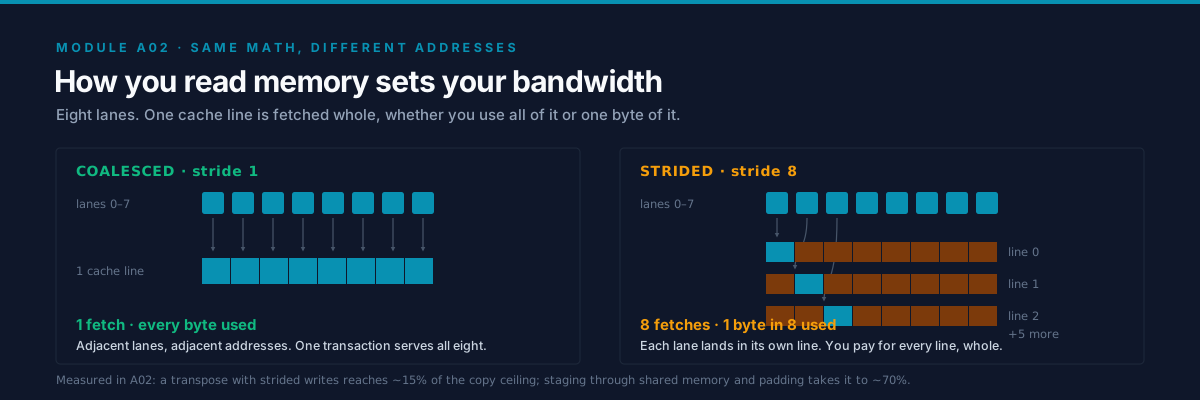
The amber cells are bytes the hardware fetched and threw away. You paid for every one of them.
Derive shared memory from reuse¶
If a datum is read more than once by a block, paying the HBM latency each time is waste. Shared memory (LDS on AMD) is a small, block-private, software-managed scratchpad on-chip. The pattern is always the same three steps:
1. cooperatively LOAD a tile from global -> shared   (each thread loads a few elements, coalesced)
2. __syncthreads()                                    (barrier: tile is fully populated)
3. COMPUTE from shared memory                         (fast, random access is now cheap)
Transpose is the minimal example where this changes the access pattern itself, not just reuse. A06 applies the same three steps to a real GEMM, where the payoff is reuse rather than reordering.
3. Deep Dive¶
The hierarchy on real silicon (AMD CDNA vs NVIDIA)¶
| Level | NVIDIA (Hopper) | AMD (CDNA3 / MI300) | Scope | Notes |
|---|---|---|---|---|
| Registers | 64K 32-bit / SM | 64K / SIMD (256 VGPRs×64) | thread | spilling to "local" = HBM = slow |
| Shared / scratchpad | Shared memory, up to 228 KB/SM | LDS, 64 KB/CU | block / workgroup | banked; software-managed |
| L1 / L2 | L1 (~256 KB) + L2 (50 MB) | L1 + L2 + Infinity Cache | GPU | hardware-managed |
| Global | HBM3 ~3.35 TB/s | HBM3 ~5.3 TB/s | GPU | the "warehouse" |
Per-SKU numbers come from the AMD GPU architecture specifications; B01 §3 derives them from the architecture rather than quoting them.
Coalescing: the transaction picture¶
%%{init: {'theme': 'base', 'themeVariables': {'primaryColor': '#F8FAFC', 'primaryBorderColor': '#0891B2', 'lineColor': '#64748B'}}}%%
flowchart LR
  subgraph C["Coalesced — stride 1"]
    T0["lanes 0..31"] -->|"1 transaction"| L1["one 128B line"]
  end
  subgraph S["Strided — stride 32"]
    T1["lanes 0..31"] -->|"up to 32 transactions"| LN["32 different lines"]
  end

  classDef success fill:#10B981,stroke:#0F172A,color:#fff
  classDef warn fill:#FEF3C7,stroke:#F59E0B,color:#0F172A
  class T0,L1 success
  class T1,LN warn
Alignment matters too: even stride-1 access that starts misaligned can straddle two lines and cost an extra transaction. Framework tensors are allocated aligned for exactly this reason.
Shared-memory bank conflicts¶
Shared memory is split into 32 banks (4-byte words
interleaved). A warp can service 32 accesses
in one cycle iff they hit 32 distinct banks (or all read the same address → broadcast). If k
lanes hit the same bank at different addresses, that is a k-way conflict → serialized into k
cycles.
The tiled transpose reads the shared tile by column (tile[threadIdx.x][threadIdx.y]). With a
[32][32] tile, column c lives entirely in bank c → a 32-way conflict. The fix is a
one-word pad:
%%{init: {'theme': 'base', 'themeVariables': {'primaryColor': '#F8FAFC', 'primaryBorderColor': '#0891B2', 'lineColor': '#64748B'}}}%%
flowchart TB
  A["tile[32][32]<br/>column stride = 32 words"] -->|"column read"| AC["all lanes -> same bank<br/>32-way conflict (serialized)"]
  B["tile[32][33] (padded)<br/>column stride = 33 words"] -->|"column read"| BC["lanes -> 32 distinct banks<br/>conflict-free (1 cycle)"]

  classDef warn fill:#FEF3C7,stroke:#F59E0B,color:#0F172A
  classDef success fill:#10B981,stroke:#0F172A,color:#fff
  class A,AC warn
  class B,BC success
[!NOTE] AMD LDS has 32 banks of 4 bytes as well (per 32-lane half of a 64-lane wavefront on CDNA), so the
+1padding trick is portable. Always confirm with the profiler —rocprofv3/ Nsight Compute both report a bank-conflict metric.
Why transpose is the perfect teaching kernel¶
Transpose reads in[y][x] and writes out[x][y]. One of read/write is always against the grain:
- Naive: reads along rows (coalesced) but writes along columns (stride = row width → each wavefront scatters across N cache lines).
- Tiled: load a tile row-wise (coalesced read), transpose inside shared memory, write the output tile row-wise (coalesced write). The strided access now happens in fast on-chip memory — and the padded version makes even that conflict-free.
4. Hands-On Labs¶
All commands run from this module directory.
# AMD
make hip GPU_ARCH=gfx942     # build hip/ programs
make run-hip                 # run them

# NVIDIA
make cuda SM_ARCH=sm_90      # build cuda/ programs
make run-cuda

# Triton (either vendor)
python triton/transpose.py
The drills are self-contained too: exercises/ and solutions/ each
have their own Makefile, so you can cd exercises && make run without coming back here. From this
directory, make exercises / make solutions build them in place, and make clean cleans all three.
Lab 1 — Find your HBM ceiling (bandwidth)¶
Files: hip/bandwidth.cpp · cuda/bandwidth.cu.
A fully coalesced grid-stride copy. What to observe: the reported GB/s — this is your practical HBM ceiling. Write it down; every other kernel in this track is judged against it. Compare to the datasheet peak (MI300X ≈ 5.3 TB/s, H100 ≈ 3.35 TB/s); you should land at a healthy fraction.
Lab 2 — Transpose: coalescing + shared memory + bank conflicts (transpose)¶
Files: hip/transpose.cpp · cuda/transpose.cu ·
triton/transpose.py.
Three kernels, one result. What to observe: naive is a fraction of peak (strided writes);
tiled jumps up (both global accesses coalesced); tiled+padded edges higher still (bank conflict
removed). All three print PASSED — the point is the bandwidth delta, not correctness.
Lab 3 (optional) — Profile the conflict¶
# AMD
make profile-hip     # rocprofv3 summary
# NVIDIA
make profile-cuda    # nsys timeline; then: ncu --set full ./cuda/transpose.exe
What to look for: in Nsight Compute, the tiled kernel shows shared-memory bank conflicts
and the tiled+padded kernel shows ~0. In the memory chart, naive shows poor global
load/store efficiency.
5. Performance Analysis¶
The right question is unchanged from A01: memory-bound or compute-bound? Transpose does zero arithmetic, so it is 100% memory-bound — a pure test of access pattern.
Representative shape of results¶
Captured on AMD MI300X (gfx942, ROCm 6.2), n = 4096. Numbers vary by GPU; the ratios are
the lesson.
| Kernel | Access pattern | Effective BW | vs peak |
|---|---|---|---|
bandwidth (copy) |
coalesced R+W | ~4800 GB/s | ceiling |
transpose_naive |
coalesced R, strided W | ~700 GB/s | ~15% |
transpose_tiled |
coalesced R+W, bank conflicts | ~2600 GB/s | ~54% |
transpose_tiled_padded |
coalesced R+W, conflict-free | ~3400 GB/s | ~70% |
%%{init: {'theme': 'base', 'themeVariables': {'primaryColor': '#F8FAFC', 'primaryBorderColor': '#0891B2', 'lineColor': '#64748B'}}}%%
flowchart LR
  N["naive<br/>~700 GB/s"] -->|"+ shared-mem tiling<br/>~3.7x"| T["tiled<br/>~2600 GB/s"]
  T -->|"+ pad to kill<br/>bank conflict ~1.3x"| P["padded<br/>~3400 GB/s"]

  classDef warn fill:#FEF3C7,stroke:#F59E0B,color:#0F172A
  classDef mid fill:#0891B2,stroke:#0F172A,color:#fff
  classDef success fill:#10B981,stroke:#0F172A,color:#fff
  class N warn
  class T mid
  class P success
Optimization delta to internalize: ~5× total from naive → padded, with the matrix values never changing. Access pattern, not arithmetic, is the lever for memory-bound kernels — the concrete proof of A01 §5's claim. B02 turns "memory-bound" from a label into an arithmetic intensity you can compute, and B03 shows how to prove the mechanism behind each rung of this ladder with counters rather than bandwidth alone.
6. Challenges, Drawbacks & Tradeoffs¶
%%{init: {'theme': 'base', 'themeVariables': {'primaryColor': '#F8FAFC', 'primaryBorderColor': '#0891B2', 'lineColor': '#64748B'}}}%%
flowchart TD
  Q{"Memory kernel too slow?"}
  Q -->|low global efficiency| E1["Uncoalesced access"]
  Q -->|shared mem, still slow| E2["Bank conflicts"]
  Q -->|occupancy dropped| E3["Too much shared mem / regs per block"]
  Q -->|correct sometimes| E4["Missing __syncthreads()"]

  E1 --> F1["Reorder so lanes hit consecutive addrs;<br/>stage via shared memory"]
  E2 --> F2["Pad shared tile (+1) or change layout"]
  E3 --> F3["Shrink tile / block; balance vs reuse"]
  E4 --> F4["Barrier after load, before compute"]

  classDef warn fill:#FEF3C7,stroke:#F59E0B,color:#0F172A
  classDef success fill:#10B981,stroke:#0F172A,color:#fff
  class Q,E1,E2,E3,E4 warn
  class F1,F2,F3,F4 success
Pitfall 1 — Forgetting __syncthreads()¶
Between the shared-memory load and the read-back you must barrier, or a thread may read a tile
slot another thread hasn't written yet. Silent, nondeterministic wrong answers. (Also: never put
__syncthreads() inside divergent control flow — all threads in the block must reach it.)
Pitfall 2 — Shared memory kills occupancy¶
Shared memory is a per-SM/CU budget. A [32][33] float tile is ~4.2 KB/block; ask for too much and
fewer blocks stay resident, hurting latency hiding. Bigger tiles = more reuse but lower
occupancy — measure, don't assume
(A03 §3 formalizes occupancy and
gives you the arithmetic).
Pitfall 3 — Bank conflicts hide behind "I used shared memory"¶
Using shared memory is necessary but not sufficient. The tiled kernel is on-chip yet still
leaves ~30% on the table to a 32-way conflict. Always check the profiler's conflict metric.
Pitfall 4 — Padding wastes a little memory¶
The +1 column is dead storage that exists purely to shift bank mapping. It is almost always worth
it, but it is a real (tiny) memory cost and a non-obvious line — comment it.
[!TIP]
📐 Reference — quick coalescing & bank-conflict checklist¶
- Coalesced? Do adjacent lanes (
threadIdx.xneighbors) touch adjacent global addresses? If the fastest-varying index is multiplied by anything but 1, suspect striding.- Aligned? Base pointers from
hipMalloc/cudaMallocare aligned; your indexing can still misalign — keep the innermost stride = 1.- Bank conflict? Any shared array indexed by a column with stride = 32 (or a multiple) → pad the minor dimension by 1, or transpose the layout.
- Barrier? Exactly one
__syncthreads()between the shared load and the shared read, reached by all threads.- Verify with the profiler, never by eye: Nsight Compute L1/shared section, or
rocprofv3bank-conflict / access-efficiency counters.
7. Real-World Use Cases¶
- Every tiled GEMM / convolution (cuBLAS, rocBLAS, CUTLASS, MIOpen) is this shared-memory staging pattern scaled up — A06 builds it. Transpose is the "hello world" of tiling.
- Attention kernels (FlashAttention) tile Q/K/V through shared memory precisely to turn bandwidth-bound global traffic into on-chip reuse — A07 and A09.
- Layout choices in frameworks (NCHW vs NHWC, contiguous vs channels-last) are coalescing decisions: the "right" layout is the one that makes the hot kernel's inner stride 1.
torch.compile/ Triton autotuning searches block/tile sizes that maximize coalesced traffic and occupancy — the automated version of this lab's manual sweep, and the subject of A08.
Where to go next. A03 explains the occupancy budget that decided your tile size here. A06 reuses this module's load-barrier-compute pattern on a kernel where the payoff is arithmetic reuse, not just reordering. B03 replaces "the bandwidth went up" with a counter that names the cause.
8. Cited References¶
Every source this module leans on is shared with other modules, so each is cited by anchor into the master bibliography, where the URL and its retrieval date live.
- CUDA C++ Best Practices Guide — the normative rules for coalescing, shared memory, bank conflicts and alignment. Read this before arguing with the profiler.
- Optimizing Matrix Transpose in CUDA (Ruetsch and Micikevicius, 2009)
— the naive/tiled/padded progression Lab 2 reproduces, and the origin of the
+1padding trick. - How to Access Global Memory Efficiently (Harris) — the transaction model §2 derives coalescing from.
- AMD CDNA architecture and the GPU architecture specifications — LDS banking and per-SKU sizes for the §3 table.
- HIP Programming Guide — the AMD
spelling of shared memory and
__syncthreads(). - Roofline (Williams et al., 2009) — why bandwidth, not arithmetic, is the ceiling for every kernel in this module.
9. Self-Assessment & Interview Drills¶
Conceptual (answers below)¶
- A warp reads
A[threadIdx.x * 2](stride 2). Roughly what fraction of the fetched bytes is useful, and why? - You add shared memory to a kernel and it gets slower. Name two distinct causes.
- Why does padding a
[32][32]shared tile to[32][33]remove a bank conflict? What does it cost? - In the tiled transpose, exactly where must
__syncthreads()go, and what breaks without it? - Your copy kernel hits 90% of peak but your transpose (naive) hits 15%. Both move the same bytes — explain the gap in one sentence.
Answers
- ~50%. Stride 2 means consecutive lanes are 8 bytes apart; a 128-byte line holds the data for only ~16 of the 32 lanes' useful words while the line is fetched whole — half the transferred bytes are unused (worse for larger strides).
- (a) Bank conflicts serialize the shared accesses; (b) reduced occupancy — the shared
allocation lowers resident blocks, so latency is no longer hidden. (Also: an unnecessary
__syncthreads()adds a barrier cost.) - A 33-word row stride makes column
c's elements land in banks(c*33) mod 32 = c*1→ 32 distinct banks instead of all in bankc. Cost: one extra word per row of shared memory (dead storage). - Between the global→shared load and the shared→global read-back — one barrier reached by all threads in the block. Without it, threads read tile slots not yet written → nondeterministic wrong output.
- The transpose's writes are strided (column-major), so each wavefront scatters across many cache lines — most fetched/stored bytes are wasted — while the copy is fully coalesced.
Coding & Algorithms drills¶
Do these in exercises/; reference answers in solutions/. Expected
terminal output (PASS and instructive FAIL states) is in
exercises/README.md → Sample sandbox output.
- Coalesce a strided kernel (
exercises/01_coalesce.cpp) — a scale kernel reads with a bad stride; restructure the indexing so adjacent lanes hit adjacent addresses, and measure the BW before/after. - Fix the bank conflict (
exercises/02_bank_conflict.cpp) — a shared-memory column reduction has a 32-way conflict; fix it with padding (or a layout change) and prove the speedup. - Hierarchy sizing (
exercises/03_hierarchy.md) — given per-SM shared-memory and register budgets, reason about the largest tile you can use while keeping ≥2 resident blocks.
Stretch¶
- Sweep
TILE ∈ {8,16,32}in the transpose and plot BW vs tile size; explain the curve using occupancy vs reuse. - Port the padded transpose to Triton with an explicit block size and match the C++ bandwidth.